
Choosing an inbound marketing agency means finding a team that understands your business, shares your goals, and can help you turn your marketing efforts into measurable results. You want to be able to work well with them and trust the decisions they make on your behalf.
Inbound marketing requires a combination of strategy, content, technology, and coordination with sales. Managing all of these areas takes time and resources, which is why many brands choose to work with an agency that brings the right expertise and support.
But how do you know which agency is right for you? In this article, we’ll walk you through the key questions to ask, the capabilities to look for, and the criteria that will help you choose an inbound marketing partner for your brand.


How To Choose An Inbound Marketing Agency, Step By Step
Before you start comparing agencies, take some time to define what you need from the relationship. The following questions will help you set priorities and evaluate potential partners.
1) Considering What You Need From Your Agency
Choosing the right agency starts with understanding your goals, your internal resources, and the support your team needs. These considerations will help you narrow your search.
Do you need a provider or a strategic partner?
There are two common ways to work with an agency:
- If you are looking for a strategic partner, you need a team that can assess your current situation, challenge assumptions, and help you decide where to focus. Your company and the agency work together to develop and refine the strategy.
- If you are looking for a provider, you may already have a strategy and need specialists to carry out specific activities, such as content creation, email campaigns, or marketing automation.
Many relationships combine both approaches. The important thing is to agree on who makes decisions, who handles each task, and how involved your internal team will be.
Are you focused on activities or business outcomes?
Before you hire an agency, agree on what success looks like and how you will measure it.
An activity-based plan defines what the agency will deliver, such as a series of articles, an ebook, and a monthly webinar. This helps you plan resources and maintain a consistent publishing schedule.
An outcome-based plan focuses on what those activities should achieve, such as attracting qualified leads, creating sales opportunities, or contributing to revenue. These goals require clear definitions and shared responsibilities, especially when results depend on your sales team as well as the agency.
The strongest plans connect both. You should know what the agency will do, why those activities matter, and how you will evaluate their contribution. Lead volume alone is not enough: consider lead quality, conversion rates, and whether the opportunities match your target customers.
What role does inbound play in your wider marketing strategy?
Think about how inbound marketing will work alongside your other marketing and sales activities. Content, SEO, email, paid campaigns, and direct outreach should support a consistent customer experience.
Ask whether the agency can coordinate these activities or work effectively with the teams and partners already responsible for them. For example, paid campaigns can help distribute useful content, while insights from sales conversations can reveal topics your audience needs help with.
You do not need one agency to manage everything, but you do need a clear plan for how the different channels and teams will work together.
How will marketing and sales work together?
An inbound marketing agency can help attract and nurture potential customers, but you need to decide what happens when those contacts are ready for a sales conversation.
Consider whether you need an agency to:
- Focus on marketing and pass qualified leads to your internal sales team.
- Help align marketing and sales by defining qualification criteria, setting up CRM workflows, and improving the handoff process.
- Support specific sales activities, if these are included in its services.
Agree on what makes a lead qualified, who follows up, and how sales feedback reaches the marketing team. Shared CRM data and regular communication will help both sides understand which activities create useful opportunities and where the process needs improvement.
2) Evaluating The Candidates
Once you know what you need from an agency, you can start comparing potential partners. Use the same criteria for each candidate so you can assess their strengths and decide which questions to explore further.
What services do they offer?
Check whether the agency clearly explains its services, how it works, and how it structures its fees. Can it provide the support you need? Which activities are handled internally, and which involve external specialists?
Look at its clients and examples of previous work. These can help you understand how the agency approaches challenges similar to yours. Focus on the thinking behind the work and the results, as well as the quality of the creative execution.
What do external reviews and rankings say about them?
Client reviews and industry rankings can help you get a broader picture of an agency before you contact them. Look at what clients say about their experience, check how each ranking evaluates agencies, and consider whether those criteria match your priorities.
For example, Cyberclick is ranked #4 among the best marketing agencies in Spain by Marketer Coffee. Use references like this as a starting point, then take a closer look at the agency’s services, relevant experience, and results to decide whether they are a good fit for your brand.
How do they build lasting client relationships?
Long-term client relationships can tell you something about an agency’s consistency, communication, and ability to adapt as a business grows.
Ask about client retention, how long typical collaborations last, and why clients choose to stay. If the agency shares a retention rate, make sure you understand the period and how it is calculated.
No agency retains every client forever. What matters is whether it can explain how it earns trust, addresses problems, and keeps delivering value over time.
Do they have relevant industry experience?
Experience with businesses similar to yours can help an agency understand your audience, sales cycle, and competitive landscape. Ask for examples that relate to your goals, whether that means generating B2B sales opportunities, supporting ecommerce purchases, or entering a new market.
An agency does not need to work exclusively in your sector to be a good fit. Experience in other industries can bring useful perspectives. Look for relevant expertise and a willingness to learn about your business, and ask how it handles potential conflicts when working with competitors.
How do they use metrics and reports?
Ask how the agency evaluates performance, which metrics it recommends for your goals, and how often you will review results together.
Reports should help you understand what is working, what needs attention, and what the agency plans to change. Depending on your objectives, that might include qualified leads, conversion rates, customer acquisition costs, sales opportunities, and revenue contribution.
It is also worth discussing how the agency connects marketing activity with sales outcomes. Ask what data it needs, how it uses your CRM, and what limitations may affect its conclusions. A useful report should explain the results and guide your next decisions.
What are their strengths and limitations?
No agency excels at every service or suits every business. Ask where the team has the most experience, which projects are a strong fit, and when it would recommend another specialist.
You should also understand its capacity. Who will work on your account? How does it manage busy periods? What happens if your needs change?
An agency that discusses its limitations openly gives you a clearer basis for deciding whether the relationship will work. Look for realistic commitments and clear explanations of how it will deliver.
How do they keep their knowledge up to date?
Ask how the agency keeps up with changes in marketing, technology, and customer behavior. Does the team take part in ongoing training? How does it test new approaches before recommending them to clients?
Request a practical example of something it has recently learned, tested, or changed. This will tell you more than a list of certifications alone.
The goal is to find a team that can evaluate new developments and explain which ones matter for your business.
How do they use AI in their work?
Ask the agency how it uses artificial intelligence to support its clients’ marketing strategies. Can it show you practical examples of how AI helps analyze data, personalize communications, or automate repetitive tasks? The team should be able to explain where AI adds value and how it measures its impact.
It is also important to understand how the agency reviews AI-generated content, handles your company’s data, and keeps people involved in key decisions. If AI is part of the service, ask who is responsible for reviewing the work and how the team makes sure it meets your brand’s standards.
A useful follow-up is to ask the agency to walk you through a specific workflow: what information goes into it, what the AI does, what a person checks, and how the final output is approved.
3) Collecting The Final Information Pieces
Once you have narrowed your search to two or three agencies, it’s time to discuss how the collaboration would work in practice. These questions will help you compare proposals and set clear expectations before making a decision.
- What is their action plan for your brand? Ask for a proposal that connects your goals with specific activities, priorities, and a budget. The agency should explain what it recommends, why it matters, and what it needs from your team. It should also distinguish between what it can deliver directly and outcomes that depend on factors such as your sales process, budget, or market conditions.
- Who is in charge of creating and approving content? Decide which tasks your team will handle and which the agency will manage, from research and interviews to writing, design, and distribution. If AI is involved, clarify how the content will be checked for accuracy, originality, and consistency with your brand. Agree on who gives final approval and how revisions will be handled.
- What should you expect after kickoff? Ask the agency to walk you through its onboarding process. What access, information, and resources will it need? Which activities will come first? Agree on initial milestones and when you will review progress, keeping in mind that different activities take different amounts of time to produce meaningful results.
- Who will you work with? Meet the people who will manage your account and carry out the work. Ask about their experience, responsibilities, and availability. You should know who your main contact is, how often you will meet, and what response times you can expect.
- How do they manage changes or emergencies? Priorities can shift, campaigns can underperform, and unexpected issues can arise. Ask how the agency handles urgent requests, who makes decisions, and how changes affect the agreed scope, timelines, and fees.
- What tools will they use, and how will they connect with yours? Ask how the agency’s tools will work with your CRM, analytics, website, and other systems. If you already use HubSpot, working with a HubSpot Solutions Partner can help you coordinate marketing and sales within the same platform. Discuss whether the team can work within your existing setup, who owns the accounts and data, what access each team needs, and how that access will be managed when the collaboration ends.
- How do they approach search visibility? Ask how the agency helps potential customers find your content through search engines and AI assistants. It should be able to explain its approach to SEO and generative engine optimization (GEO), how it monitors visibility, and what it can reliably measure. Discuss how it connects that work with qualified traffic and business opportunities, and be cautious about promises of guaranteed rankings or mentions in AI answers.
- What payment model do they use? Confirm whether fees are based on a monthly retainer, individual projects, or another arrangement. The proposal should clearly explain what is included, which costs are separate, and how additional work is approved. Review the contract length, cancellation terms, and handover process so both sides understand their commitments.
7 Tips For Choosing The Best Inbound Marketing Agency For Your Brand
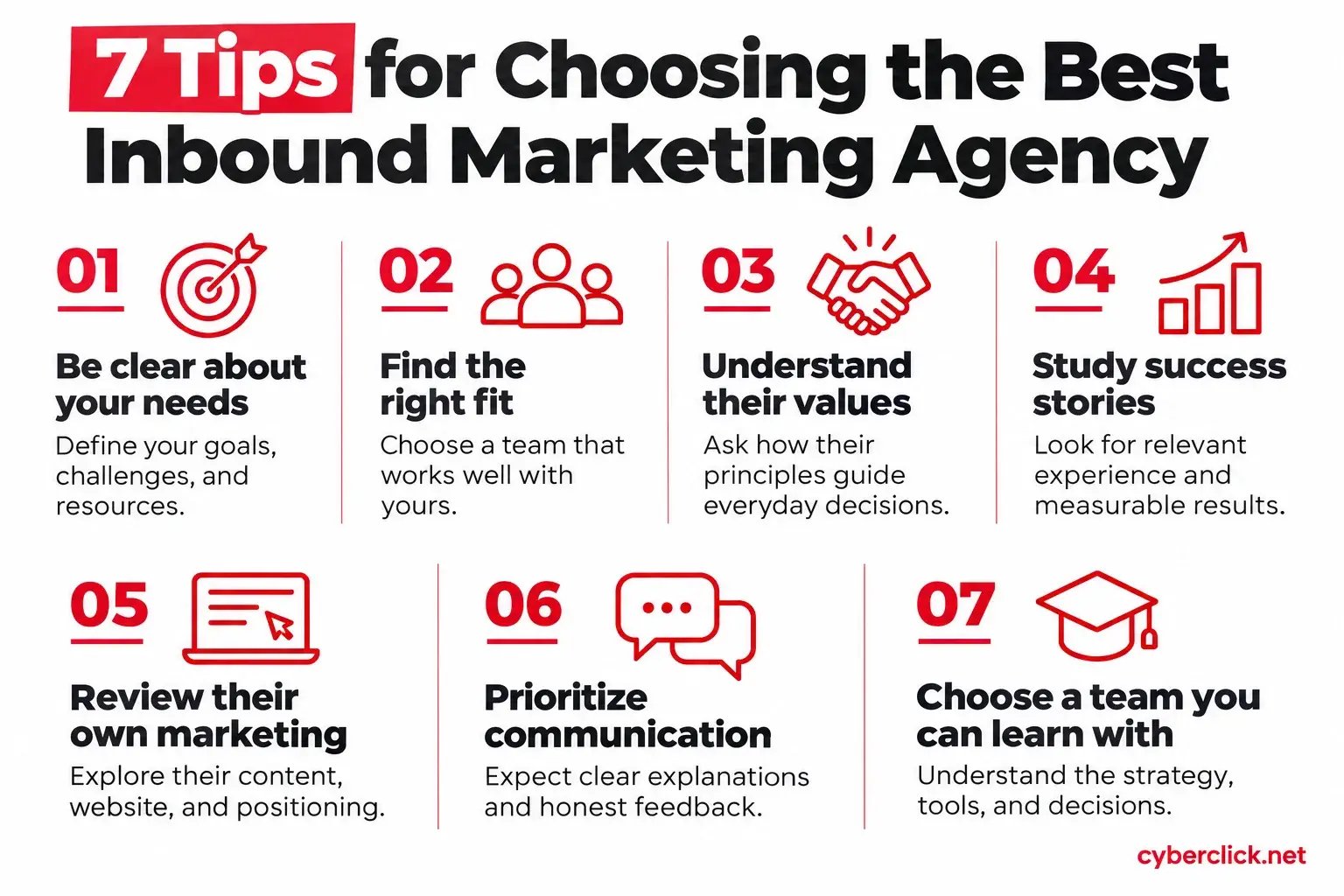
- Be clear about what you need. Share your goals, challenges, and available resources with the agency. If you are still defining your priorities, explain where you need guidance. The more context you provide, the easier it will be for the team to recommend a realistic approach.
- Find the right fit. Look for an agency whose working style complements your own. Consider how it involves your team, responds to feedback, and makes decisions. A successful collaboration needs both relevant expertise and a relationship that works in practice.
- Learn about the agency’s philosophy and values. Ask how its values influence everyday work, from handling disagreements to communicating results. At Cyberclick, our three core values are “Admire people,” “Always find a better way,” and “Customer experience freaks.” Conversations about values can help you understand what to expect beyond the proposal.
- Study relevant success stories. Look for examples that explain the client’s challenge, the agency’s approach, and the results achieved. Ask what the team learned and how that experience could apply to your business. If possible, speak with a client whose needs are similar to yours.
- Look at how they market themselves. Explore the agency’s website, content, emails, and social channels. Does it provide useful information? Is its positioning clear? Its own marketing can give you a sense of its expertise and attention to detail, although you should also consider its client work.
- Pay attention to communication. Notice whether the team listens carefully, asks useful questions, and explains its recommendations clearly. Agree on how you will share feedback and discuss performance. You should feel comfortable raising concerns and confident that you will receive an honest answer.
- Choose a team you can learn with. A good agency should help you understand the strategy, the results, and the reasons behind its decisions. Whether it is introducing an automation workflow or testing an AI tool, the team should explain the benefits and limitations so you can make informed decisions together.
Choosing an inbound marketing agency comes down to finding a partner with the expertise, transparency, and working approach your business needs. Take time to compare your options, meet the team, and agree on what success will look like. If you are ready to explore an approach tailored to your goals, discover how Cyberclick’s inbound marketing services can help you attract qualified audiences, nurture leads, and connect your marketing efforts with sales opportunities.


David Tomas
CEO and co-founder of Cyberclick. David Tomas has more than 25 years of experience in the online world. He is an engineer and completed an Entrepreneurship program at MIT, Massachusetts Institute of Technology. In 2012 he was named one of the 20 most influential entrepreneurs in Spain, under the age of 40, according to Global Entrepreneurship Week 2012 and IESE. Author of "The Happiest Company in the World" and "Diary of a Millennial".



Leave your comment and join the conversation