
Choosing a CRM is no longer just a tech decision. It’s a strategic choice that affects how you attract customers, manage opportunities, and align marketing, sales, and service. Picking the wrong one can create internal tension, while the right one can become your main growth engine.
In this article, we look at five of the most popular solutions for businesses on the market today: HubSpot, Salesforce, Microsoft Dynamics 365, Pipedrive, and Zoho. We get into usability, scalability, automation, and integration.


Elements of a Strong CRM System
Before looking at specific tools, it’s important to know what a business CRM should deliver. It’s not just about features, but about how it impacts daily operations and business growth. A solid CRM system offers:
- Unified view of the customer: All info, interactions, and opportunities in one place, with no confusion between marketing, sales, and service.
- Process automation: Workflows that cut down manual tasks, automatically assign leads, send personalized communications, and trigger internal alerts.
- AI that helps the business: AI that predicts outcomes, improves processes, generates content, analyzes data, and supports sales decisions.
- Integration with your digital tools: Smooth integration with marketing, advertising, finance, customer service, and analytics tools.
- Expansion opportunities: The system grows with your team and includes a wide range of innovative features.
- Ease of adoption: An intuitive interface that your team can start using right away, without relying on technical experts.
With these criteria in mind, let’s see what each one of the five CRMs we've selected brings to the table.
Direct Comparison: HubSpot vs Salesforce vs Dynamics 365 vs Pipedrive vs Zoho
When comparing HubSpot, Salesforce, Microsoft Dynamics 365, Pipedrive, and Zoho, the difference isn’t whether they manage contacts or create opportunities—all of them do that. The real difference lies in approach, complexity, team integration, and how easy it is to deliver value from day one.
Some platforms focus on advanced customization, while others center around sales simplicity. There are also those that aim to integrate the full enterprise architecture, and others that prioritize a connected platform that brings marketing, sales, and service together in one database.
AI has also become a differentiating feature. HubSpot, for instance, has integrated AI for content, automation, data analysis, and sales assistance directly into the user experience. Other systems offer AI for advanced analytics or specialized setups.
The following table breaks down the main focus of tool:
|
CRM |
Main Focus |
Technical Complexity |
Practical Use of AI |
Best Fit for |
|
HubSpot CRM |
Global platform connecting marketing, sales, and service |
Medium with high growth potential |
Integrated into content, automation, analytics, and sales |
Small, mid, and large businesses looking to grow without switching systems |
|
Salesforce CRM |
Extreme customization and complex processes |
High |
Focused on prediction and advanced analytics |
Large organizations with complex structures |
|
Microsoft Dynamics 365 |
Enterprise integration within Microsoft ecosystem |
High |
Focused on analytics and business optimization |
Companies already using Microsoft technology |
|
Pipedrive |
Visual sales pipeline optimization |
Low |
Basic sales process automation |
Sales teams prioritizing simplicity |
|
Zoho CRM |
Integrated business suite |
Medium |
Zia AI for analysis and recommendations |
Businesses looking for multiple apps under one provider |
When comparing the tools, you may also want to consider that:
- HubSpot stands out for offering a global platform that connects marketing, sales, and customer service in one place, no matter the company size. It combines advanced automation, ease of use, and AI integration, so small teams can get started quickly, and large organizations can scale without switching systems.
- Salesforce and Dynamics 365 shine when the priority is mostly on process customization and managing complex organizational structures.
- Pipedrive works best when the focus is on organizing the sales pipeline without adding extra complexity.
- Zoho gives you a wide range of features within its own business ecosystem.
HubSpot CRM
HubSpot CRM is built on the idea that marketing, sales, and service should work on the same database, sharing context in real time and eliminating silos.
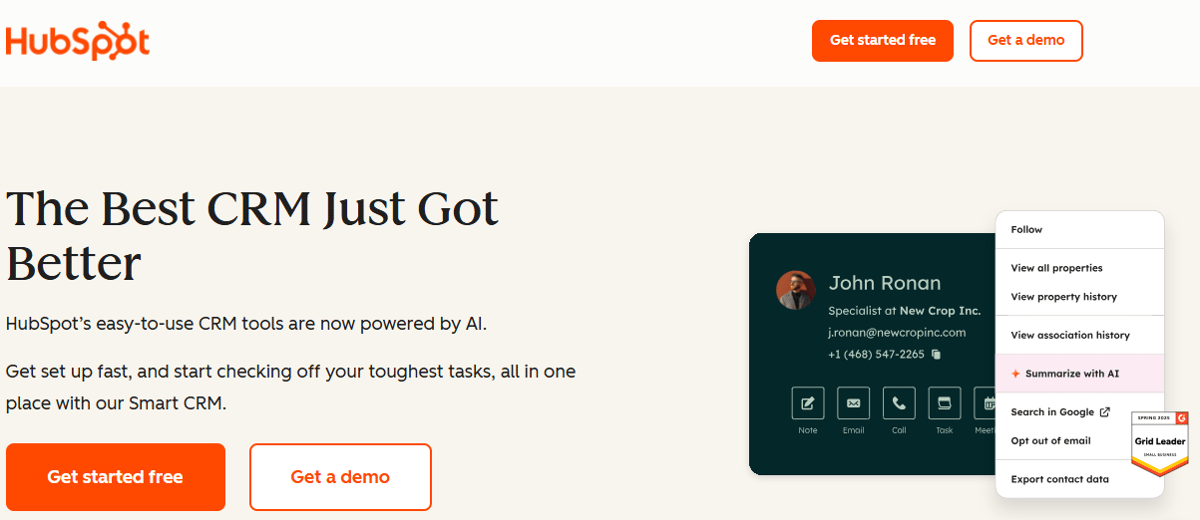
All contact information, like emails, calls, forms, open or closed deals, and support tickets, lives in one record. This gives every team a complete view of the customer without depending on other departments.
A big pro is that it’s not only for startups or large companies. It works for small, mid, and large businesses, growing alongside the company without forcing a switch when things get more complex.
Its main functionalities include:
- Full contact, company, and opportunity management
- Creating assets like landing pages, emails, and automations within the system
- Native integration across marketing, sales, and service
- Customizable reporting dashboards
- AI applied across all processes through the Breeze assistant, from content creation to sales analysis
The mix of operational simplicity and functional depth sets it apart. It isn't too hard to set up and grows with your business.
Building Assets
Creating a landing page with a form that triggers an automated email is an integral part of most digital marketing strategies out there, but the time and complexity it takes to set up this workflow vary by CRM.
HubSpot stands out among the others for its user-friendly approach to asset creation.
|
Platform |
Landing Pages Creation Possibility? |
Email Marketing Integration? |
Customizable Workflows? |
Developer/ |
|
HubSpot |
Yes, native drag & drop editor |
Yes |
Yes |
Low |
|
Salesforce |
Not natively in Sales Cloud |
Needs additional tools |
Yes, advanced setup |
Medium/High |
|
Dynamics 365 |
No, not native |
Marketing in specific modules |
Yes, within certain modules |
Medium |
|
Pipedrive |
No |
Limited or third-party |
Basic automation |
Low |
|
Zoho |
Yes, in the ecosystem |
Yes |
Yes |
Medium |
In HubSpot, the team can create a landing page, connect the form, set up the workflow, and design the email all in one place, without the need for developers. In other systems, this usually requires activating extra modules, integrating tools, or coordinating tech resources. Native integration reduces launch time and makes everything a little simpler.
Salesforce CRM
Salesforce is a highly configurable platform that is ideal for complex sales processes.
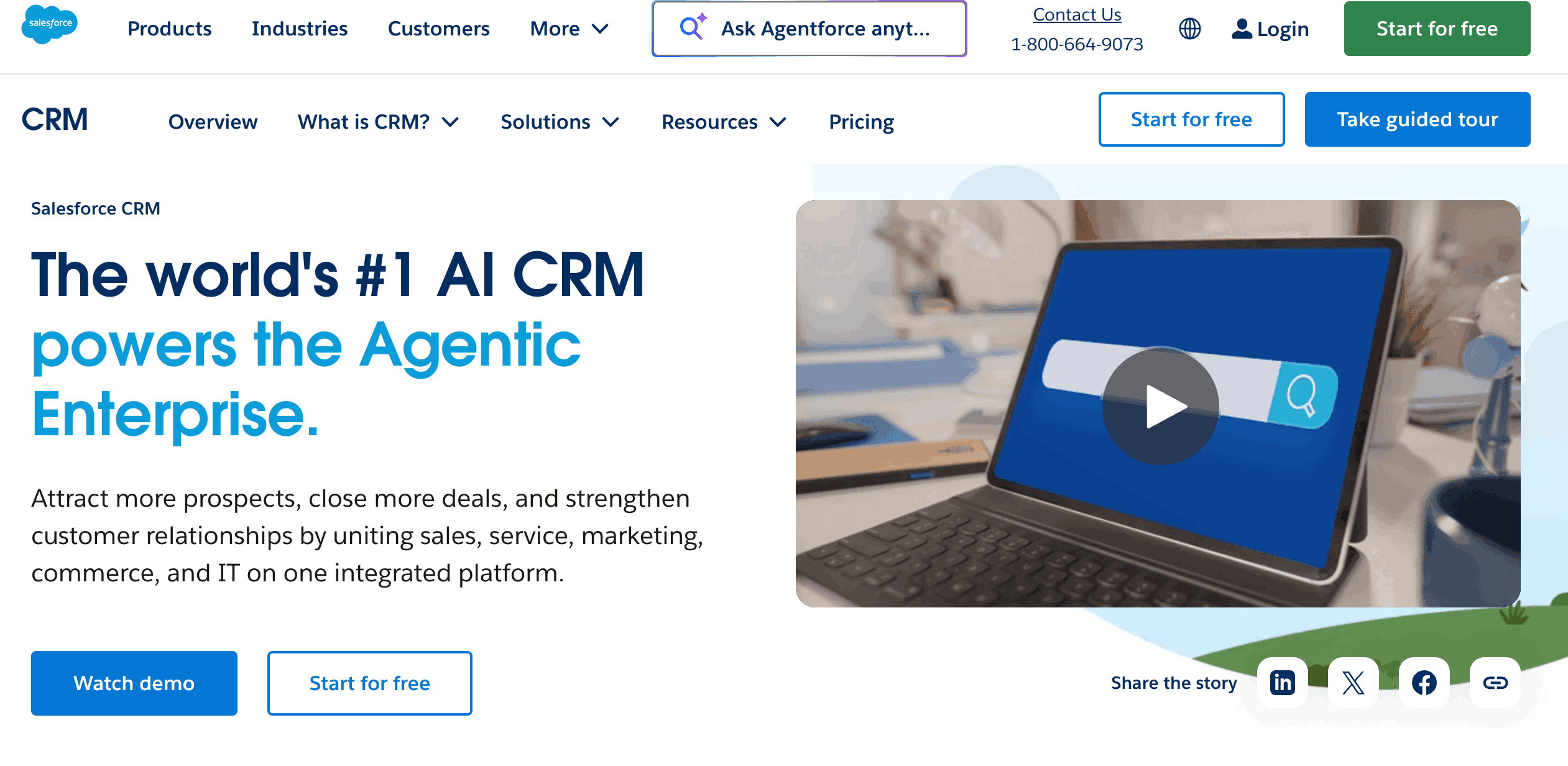
Salesforce is more than a place to log opportunities. You can model very specific workflows, create advanced automations, and customize almost every object or process within the system.
The Customer 360 approach aims to unify sales, marketing, service, and commerce around one customer view. This translates into:
- Advanced process customization
- Configurable automations
- Large ecosystem of apps and integrations
- AI-based analytics and predictions
It is ideal for large organizations with complex structures, though it may require more setup and technical support.
In short, Salesforce stands out for power and flexibility and was built for demanding scenarios where customization is a strategic priority.
Microsoft Dynamics 365 CRM
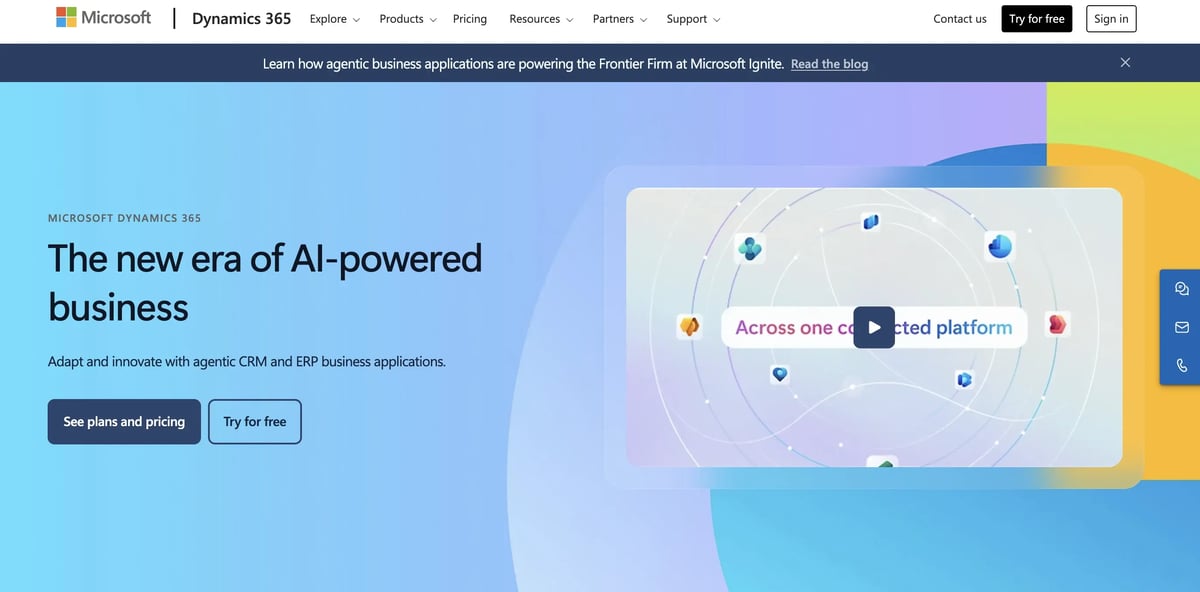
Dynamics 365 isn’t just a CRM—it’s part of a broader business suite that connects sales, finance, and operations. Its main strength is its integration with Microsoft tools like Outlook, Teams, and Power BI.
With Dynamics 365, you can:
- Manage sales and opportunities
- Automate sales processes
- Native integration with Microsoft apps
- Advanced analytics and dashboards in Power BI
- AI for predictions and recommendations
It works best for companies that want CRM and business processes under one tech architecture, prioritizing consistency with Microsoft tools over ease of initial setup.
Pipedrive
Pipedrive is a sales-focused tool that is designed to manage pipelines visually and efficiently.
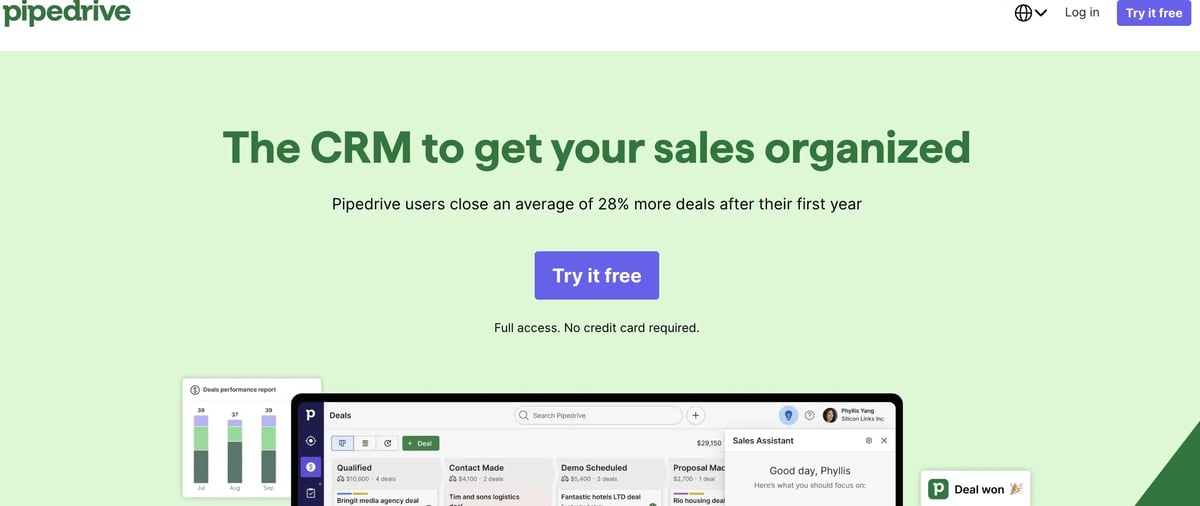
Every opportunity moves through defined stages, giving teams a clear picture of what’s in progress, stalled, or needs follow-up.
Highlights include:
- Visual pipeline management
- Tracking sales activities
- Basic sales process automation
- Team performance reports
- External tool integrations
Pipedrive is ideal for when the main goal is clarity in the sales process without extra complexity.
Zoho CRM
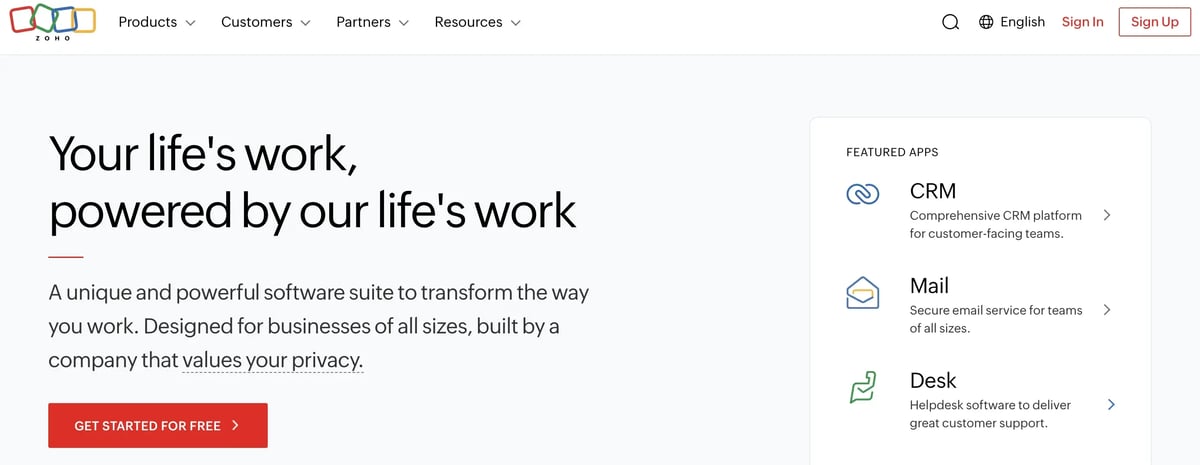
Zoho CRM is part of a wider suite of business apps. It brings together lead, opportunity, and account management with automation and AI via Zia.
Key features include:
- Lead and opportunity management
- Workflow and business rule automation
- Multichannel customer communication
- AI analytics and predictions
- Integration with other Zoho apps
Zoho works well for companies seeking a broad ecosystem under one provider that isn't just focused on the sales pipeline.
Overall Conclusions
- HubSpot: The most complete option for companies of all sizes, connecting marketing, sales, and service in one place.
- Salesforce and Dynamics 365: Best when the top priority is technical customization in complex structures.
- Pipedrive: Works well if the goal is to optimize the sales pipeline only.
- Zoho: Fits businesses looking for a broad set of apps under one provider.
In the long run, the most competitive CRM isn’t the one with the most settings, but the one that allows you to grow best.

David Tomas
CEO and co-founder of Cyberclick. David Tomas has more than 25 years of experience in the online world. He is an engineer and completed an Entrepreneurship program at MIT, Massachusetts Institute of Technology. In 2012 he was named one of the 20 most influential entrepreneurs in Spain, under the age of 40, according to Global Entrepreneurship Week 2012 and IESE. Author of "The Happiest Company in the World" and "Diary of a Millennial".


Leave your comment and join the conversation