
The stages of the marketing funnel are fundamental for any company looking to grow and scale results, especially in the complex world of digital marketing. Every modern marketing professional—whether you are setting corporate strategy or focused on daily execution—needs a clear understanding of the customer's journey from their first touchpoint to a successful conversion. Understanding where your audience is in their decision-making process is the key to allocating resources effectively and justifying your spending.
A robust marketing strategy hinges on moving potential customers through a structured process. This typically involves three main phases: the awareness stage, the consideration stage that generates the engagement, and finally, the decision stage, which facilitates the desired action. That being said, the traditional, linear model of the funnel is often too simplistic for today's dynamic customer journey. We will explore the classic model, how to adapt it for maximum impact, and the essential metrics you need to track to prove your team's success.

What Is the Marketing Funnel?
The marketing funnel is a conceptual framework that maps the path a prospect takes, starting from their initial encounter with your brand until they become a paying customer. While different models exist, the core structure is designed to guide your customer acquisition process and clarify where to apply your resources. For those focused on execution, the funnel offers a clear way to measure channel performance and demonstrate lead generation success. For strategic leaders, it is the foundation for aligning marketing investment with overall corporate growth objectives.
A common funnel has three primary funnel stages:
- Awareness stage (TOFU): This is where people recognize that they have a problem or need, but aren't thinking about specific brands yet. They are seeking general information and exploring new ideas.
- Consideration stage (MOFU): Prospects in this stage are actively researching potential solutions to the problem they identified. They are comparing methods, tools, and partners.
- Decision stage (BOFU): The prospect is ready to make a purchase. They are evaluating final vendors and looking for specific, tangible proposals, testimonials, and guarantees to commit to a solution.
The power of using the funnel is that it allows you to precisely match your content and paid media budget to the prospect’s mindset at any given time, ensuring that you are not wasting resources on the wrong message. The funnel is what gives meaning to your audience targeting efforts.
Top of the Funnel (TOFU)
The top of the funnel, or TOFU, is dedicated to maximizing visibility and starting the customer journey. This stage is purely about attention and education, not selling. Your goal is to interrupt the prospect's daily routine and present yourself as a reliable source of information, establishing the initial contact without pushing for a direct sale. For those focused on channel performance, success here means making sure that the target audience sees your brand on the most relevant channels. For executives, this is about strategic reach and building long-term brand equity.
The type of content that performs best at this funnel stage is educational and freely accessible, addressing general problems without mentioning specific products:
- Search engine optimization (SEO) and blog content: Optimizing content for problem- or trend-focused searches. This positions your brand as a helpful expert when the prospect is asking questions.
- Social ads and programmatic advertising: Running targeted campaigns on platforms like LinkedIn and connected TV to generate curiosity and build brand visibility.
- Content marketing: Creating value through articles, guides, podcasts, and webinars to generate curiosity around the industry topic.
Key metrics at the TOFU include website traffic, followers, video plays, free resource downloads, and media mentions, focusing entirely on volume and efficiency in lead generation.
Middle of the Funnel (MOFU)
Once a prospect moves into the middle of the funnel (MOFU), the goal shifts from general awareness to proving your ability to solve their problem. This is where the consideration stage takes place, and prospects are actively evaluating alternatives.
To engage this audience, you need to provide content that offers practical value in exchange for a contact method, enabling lead nurturing:
- Success stories: Demonstrating how you helped similar companies achieve their objectives. This is highly influential for technical roles needing to justify ROI and senior leaders looking for verified results.
- Whitepapers and ebooks: Offering specialized deep dives into trends and proven methodologies, often paired with personalized follow-ups. This content showcases your technical expertise and commitment to finding a better way.
- Interactive tools and demos: Providing ROI calculators, free trials, or custom demos to nurture the lead with information that helps them compare alternatives.
The crucial element here is providing clear, precise metrics and a commitment to transparency.
Bottom of the Funnel (BOFU)
The bottom of the funnel (BOFU) is the point of execution where the strategic planning turns into a tangible contract. This is the crucial decision stage where the prospect has narrowed down their options and is ready to commit to a partner. They are no longer seeking general advice but are now looking for precise terms and confidence in their choice.
Successfully navigating the BOFU requires personalized and result-oriented interactions:
- Personalized proposals: Creating a proposal that is highly customized to the client's specific business context and objectives. The proposal must define clear, specific key performance indicators (KPIs) and expected results, justifying the conversion strategy with data.
- Direct access and transparency: For technical and operational roles, this means daily reporting and constant, agile feedback loops. For senior decision-makers, it means a clear, high-level presentation of the strategy and expected returns.
- Bottom-funnel content: Using testimonials, case studies, and detailed comparisons to strengthen trust and remove friction before the purchase.
Key indicators at the BOFU include conversions, close rate, cost per acquisition, and ROI, as these directly measure the financial impact of the decision. This phase is less about volume and more about the quality and alignment of the final pitch.
Benefits of Implementing the Funnel Into Your Strategy
Adopting a structured marketing funnel provides significant benefits that address the core challenges faced by modern marketing professionals. It moves your approach away from scattered actions to a coherent, measurable system.
- Justifying investment to management: The funnel provides a clear, data-driven framework to justify every dollar spent. By attributing success to specific funnel stages, you can show management precisely how lead generation and customer acquisition efforts translate into measurable business growth.
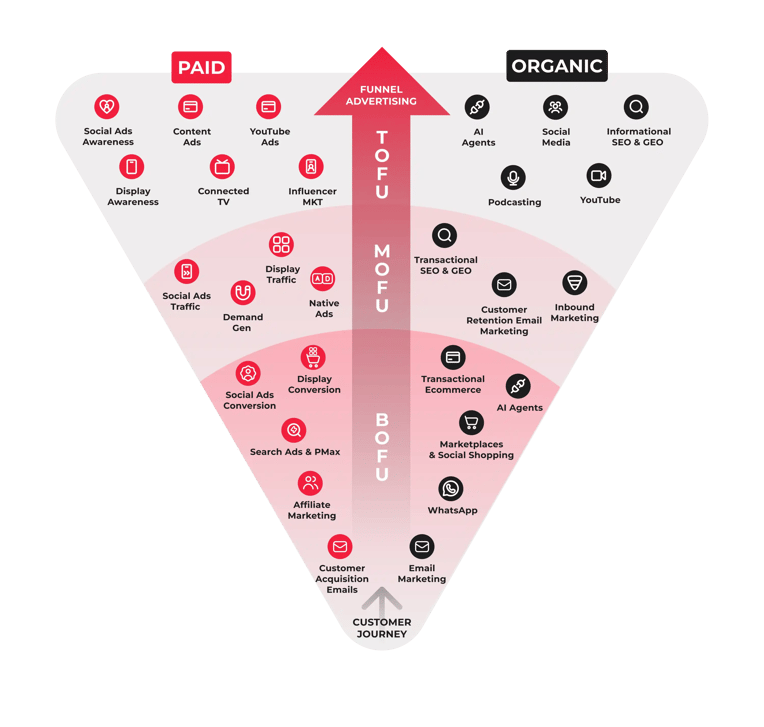
- Resource optimization: The inverted approach of funnel advertising maximizes efficiency by first investing in those most likely to convert. This lowers financial risk and guarantees early actions that bring tangible returns.
- Improved agility and responsiveness: A clearly defined funnel allows teams to react quickly to data and adjust strategies in real time, which is essential for adapting to market changes.
- Strategic alignment: The funnel ensures that operational goals are directly aligned with broader corporate objectives, such as meeting the company's growth plans.
Limitations
While the stages of the marketing funnel provide a robust framework, relying strictly on the traditional, linear model has clear limitations in today's digital landscape. The customer journey is rarely a simple, one-way path from awareness to decision. Often, it is fragmented, iterative, and non-linear.
The main challenges of the classic sales funnel model include:
- Ignoring post-conversion value: The traditional funnel ends at the point of sale. It fails to account for customer retention, loyalty, and advocacy, which are critical for sustainable growth.
- The assumption of linearity: Prospects often jump between the consideration stage and the awareness stage. The model can delay the return on investment when too many resources are spent on cold audiences.
- Lack of customer understanding: It can treat the customer as an anonymous lead rather than focusing on the person, which is vital for building long-term trust and relationships.
Loop Marketing as an Updated Approach to Allbound Marketing
To overcome the linear limitations, many marketing leaders now embrace a loop marketing model, which is an evolved perspective of allbound marketing. Loop marketing is a four-stage approach designed to combine AI efficiency and human authenticity to drive growth. This model loops, learns, and gets sharper every time you use it, turning the multiple moving parts of marketing into a momentum-building system.
Loop marketing is the collaboration between humans and AI. It follows these four stages:
- Express: Define your tone and point of view, informed by your ideal customer profile.
- Tailor: Use artificial intelligence (AI) to make your interactions personal, contextual, and relevant for your audience.
- Amplify: Diversify your content across all relevant channels for both humans and bots, expanding your reach.
- Evolve: Iterate quickly and effectively. AI helps you make changes in days, not quarters, ensuring real-time optimization.
Loop marketing ensures that your funnel optimization is a continuous cycle, not a one-time exit. It is a strategic view that is focused on long-term, sustainable growth, seeking continuous feedback for strategy refinement.
Post-Conversion Stages and Their Importance
Ignoring what happens after the sale is a missed opportunity for future customer acquisition. These post-conversion phases are critical for lifetime value and predictable growth. They provide the internal recognition and success stories needed to justify their team's ROI.
The post-conversion experience often includes:
- Loyalty: Maintaining a smooth and effective relationship during the strategy implementation is vital. This requires biweekly follow-up meetings, detailed reports, and transparency in reporting.
- Advocacy: A successful partnership should convert the client into a promoter. This is driven by campaign reviews, strategy optimization, and continuously achieving and exceeding defined KPIs. Customer reviews, referrals, and testimonials are the most powerful forms of TOFU content you can generate.
Different Definitions of the Marketing Funnel
It is helpful to recognize that the core stages of the marketing funnel adapt to different industries and business objectives, particularly depending on whether the focus is strategic or technical.
The marketing funnel can be implemented into a strategy that focuses on long-term, strategic impact that zooms in on elements like:
- Strategy and resource allocation: Making sure that the funnel aligns with corporate growth plans.
- Partner selection: Finding a reliable provider that offers both innovation and reliability.
It can also be used to obtain:
- Channel-specific performance: Ensuring the performance of a specific channel, such as social ads, is optimized.
- Immediate results: Needing fast, concrete solutions to meet and exceed established KPIs.
Regardless of the nomenclature—be it AIDA (awareness, interest, desire, action), AECP (awareness, engagement, consideration, purchase), AREA (adoption, retention, expansion, advocacy), or other variation—the goal is to maintain visibility, offer value, and track every key metric to drive sales.
Best Practices
To make sure that your marketing strategy leverages the funnel for maximum growth and efficiency, focus on these actionable best practices that stem from the funnel advertising methodology:
- Start with the bottom of the funnel (BOFU): The funnel stages should be addressed in reverse order, focusing initial efforts on users who already show clear buying intent. This generates revenue from day one, which can be reinvested to fuel the upper stages.
- Accelerate learning through BOFU data: By starting at the bottom, you quickly gather insights on which keywords convert, which objections are common, and which channels perform best. This knowledge is used to shape MOFU and TOFU campaigns, reducing guesswork.
- Prioritize a user-centric strategy: Adopt a mindset where you listen to the user, understand their concerns, and address their real needs at the exact moment of decision. This approach makes the entire journey more relevant and human.
- Personalize content by stage and persona: Combine buyer persona insights with the funnel stage to personalize the messaging, tone, format, and value proposition for maximum relevance.
- Maintain a connected funnel: Ensure that all stages work together as one system where TOFU sparks interest, MOFU builds trust, and BOFU drives decisions. Each stage strengthens the next, creating a positive cycle.


Laia Cardona
Responsible for content and brand visibility strategy at Cyberclick, with an Allbound approach and specialization in SEO, GEO (Generative Engine Optimization), and AI-powered automation. Advanced HubSpot CRM management: database segmentation, workflows, lead nurturing, scoring, and reporting. Background in digital marketing, corporate communications, and journalism—combining strategy, creativity, and technology to attract and convert qualified leads.
Leave your comment and join the conversation